This post presents highlights from a much longer piece that I posted on my Substack: “My Personal History with Information.” What follows is a much condensed version of that Substack post. A chief lesson of these highlights is that information, when taken seriously, refutes naturalism and confirms intelligent design.
Opening the Box
Context for my story with information goes back to 1979, when I converted from a New-Age eastern pantheism to Christianity. In coming to Christ, science-faith conflicts were the last thing on my mind. … My newfound Christian faith occurred without any fundamental reexamination on my part of the relation between science and faith. Nonetheless, a new worldview raises new questions and prompts the search for new answers. I wanted to make sense of my Christian faith, especially in a world often hostile to it. So I started reading widely, shifting from New Age to Christian literature.
On the apologetics front, I enjoyed Francis Schaeffer and John Warwick Montgomery, and later G.K. Chesterton and C.S. Lewis. With regard to faith and science, I read the creationist literature, both young-earth and old-earth. I quickly became a skeptic of naturalistic accounts of life’s origin and its subsequent evolution. … The mechanisms of evolution such as natural selection seemed to me too inadequate.
One thing in particular that I read convinced me a naturalistic origin of life was all washed up. It was short. It was the appendix of a book that’s still somewhere on my shelf. I read it in 1980. I was a junior at the University of Illinois Chicago Circle (subsequently renamed University of Illinois at Chicago) doing a psychology undergrad. A student I met in class and at a weekly Campus Crusade meeting recommended a book titled Close Encounters: A Better Explanation (by Clifford Wilson and John Weldon).
As in our day, UFOs and extraterrestrials had back then captured the public imagination (through such films as Steven Spielberg’s blockbuster Close Encounters of the Third Kind). Yet in the appendix to that book, for whatever reason, there was a mathematical argument against life originating by undirected means, which is to say apart from intelligence. The odds were just too much against it. The argument in that book was probabilistic and it irrevocably shifted my thinking, leading me ever after to think it absurd that the chemical constituents of life could organize themselves spontaneously into life.
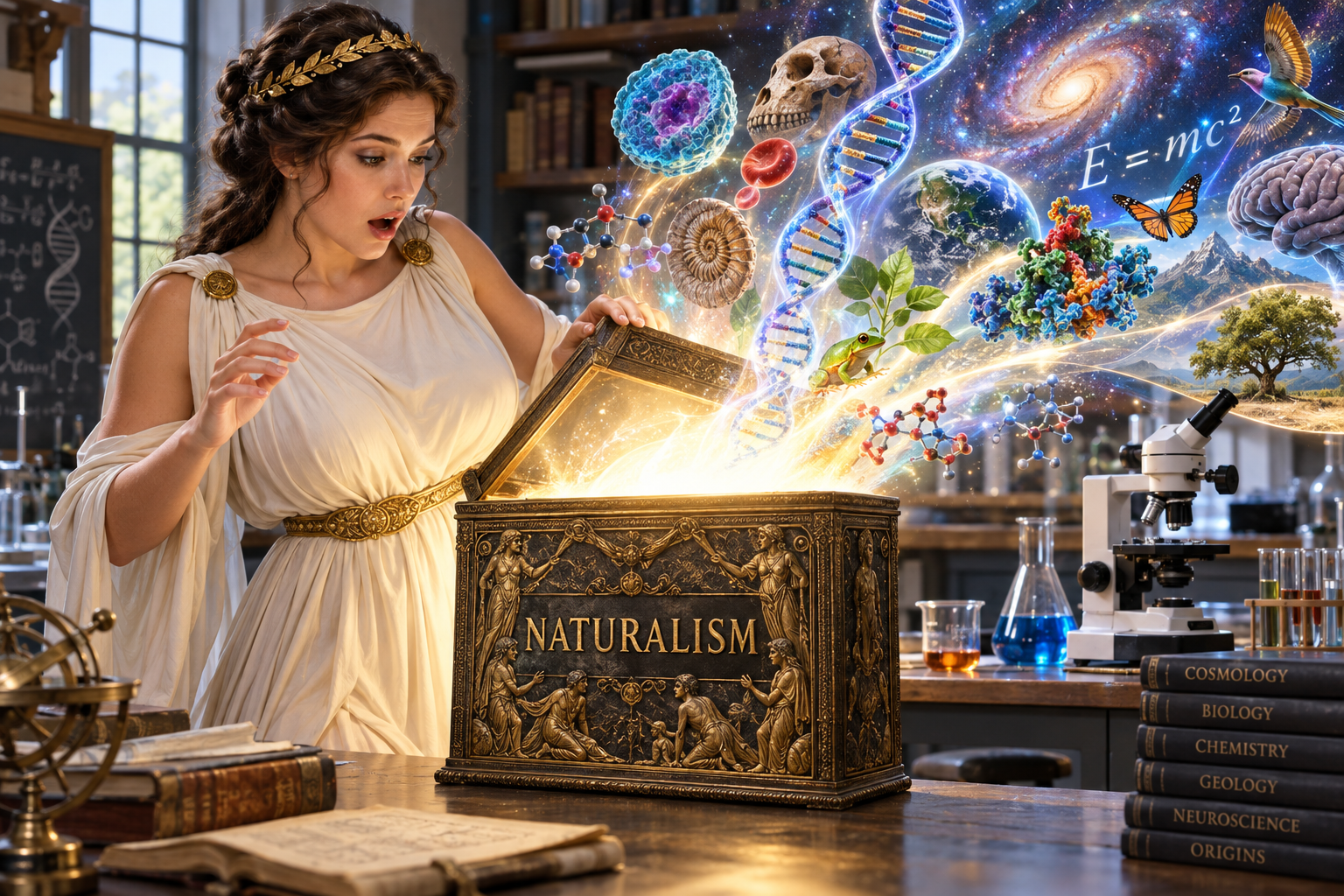
Once I had that conviction, the naturalistic blinders were off and the question then arose where else naturalism failed. Naturalism is like a Pandora’s box in that all of scientific explanation must be kept inside it. Once even one area of science comes to seem implausible to naturalistic explanation, all the contents of the box come rushing out and naturalism is no longer a rule that science is obligated to obey.
Naturalism at heart is the claim that nature is complete— Carl Sagan’s “the cosmos is all that is or ever was or ever will be.” So anything that happens in nature must be the result of things and causes in nature. But nature is under no obligation to follow that directive. It’s easy to come up with counterexamples in which natural causes provide inadequate explanations—where things happen in nature that are beyond the power of nature. Spontaneous remissions, near-death experiences, and psi phenomena—if happening as reported—can fall into this category. That’s why naturalists since antiquity have always argued for fraud or mistaken observation in such cases, and not that the phenomena in question happened as described.
[From that crack in naturalism’s monopoly, I turned to critiques of naturalistic origins on their own terms:]
It was the latter approach that intrigued me… The key figure in their circle taking the second approach was organic chemist A.E. Wilder-Smith (1915–1995).
Information in Biology
Wilder-Smith was a young-earth creationist. Yet I never got the sense from him that his young earth views did the heavy lifting in his arguments against naturalism or for intelligence in nature. … Wilder-Smith wrote a number of books… but his most significant books, in my view, were about the role of information in biology and how the type of information found in biology undercuts naturalistic attempts to explain biological complexity and function. The most important of these books was The Creation of Life: A Cybernetic Approach to Evolution (1970), in which he treated genetic systems as cybernetic and information-processing systems and argued that their programming originated through intelligence.
The issue for Wilder-Smith was not the mere existence of biomacromolecules but rather accounting for the information processing required for such molecules to arise and interact, their very arrangements and functions resulting from the execution of encoded instructions. Biology was giving us computer programming and symbolic codes which, by mapping functional structures to functional structures, exhibited a tacit semantics.
The point was similar to John Searle’s Chinese Room thought experiment, where the physical substrate could not explain the semantics atop it. Wilder-Smith was pointing to a mystery for naturalism, but a mystery in principle resolvable through the guidance of a real teleological intelligence. … it was a mystery and one he discussed with the linguist Noam Chomsky, who agreed with him that this was indeed a deep mystery.
Wilder-Smith’s 1970 book … extensively cites the 1967… Wistar symposium… [where] Stanislaw Ulam and Marcel Schützenberger, as well as engineer Murray Eden, offered a mathematical critique of neo-Darwinism. … Schützenberger pointed to the coordination problem between a computer code and what it does, analogizing this to the coordination between genotype and phenotype… randomness at the level of code or genotype [is] in the main toxic.
Random genetic changes, even with natural selection at work, thus seem like a recipe for evolution to fail. But where the Wistar mathematicians… were engaged in pure critique (‘this doesn’t work’), Wilder-Smith was looking for an intelligent design alternative (‘this is what replaces it’). … He even invokes William Paley’s design argument, though he cashes it out not in terms of a watch but in terms of information.
[Wilder-Smith’s influence ran wide—Dean Kenyon abandoned Biochemical Predestination after Wilder-Smith; Thaxton, Bradley, and Olsen’s The Mystery of Life’s Origin carried his fingerprints:]
Looking back, I would say Wilder-Smith’s intuitions were spot on. Fleshing out his arguments, however, would need to wait until the intelligent design movement came into its own…
[Two philosophy books sharpened the concept:]
Whenever I need to give an elevator pitch about what information is, I quote Stalnaker… In his book Inquiry, Stalnaker writes about information, ‘To learn something, to acquire information, is to rule out possibilities. To understand the information conveyed in a communication is to know what possibilities would be excluded by its truth.’ This remains for me to this day as good a definition of information as exists… Natural processes, to the extent that they rule out possibilities—which they can and do—thus generate information. This puts teleology and non-teleology on an equal footing vis-a-vis information…
Fred Dretske’s Knowledge and the Flow of Information confirmed Stalnaker’s definition… [Dretske:] ‘the information relationships between s and r must be distinguished from the system of [material] causal relationships existing between these points.’ The crucial insight for me… was that the information relationships made sense in the absence of any known physical causal process… Intelligent design… saw it as nonreducible to physical causality.
Randomness by Design
In the early and mid 1980s, Wilder-Smith’s ideas about information excited me but I could think of no way to contribute to them as a researcher… I was a graduate student in mathematics, focused on probability theory. I got my PhD in 1988… As I became interested in the late 1980s in radically improbable events and how they might point to the activity of intelligent causes, I didn’t see much use for information theory as such…
I had read Thaxton et al.’s The Mystery of Life’s Origin in the late 1980s… Even the term specified complexity… appeared in the book. But I didn’t see in specified complexity a direct connection to mainstream information-theoretic concepts. … We were gesturing at it. … And yet there was work to be done connecting our emerging understanding of information with the standard formalism of information theory.
[Persi Diaconis] urged me to attend a conference on randomness… at Ohio State University… When the conference ended… Persi Diaconis delivered what he took to be the upshot… “We know what randomness isn’t, we don’t know what it is.” … Randomness was always a provisional designation until such time as a pattern would be found that made clear it was not random. Thus, we always got at randomness by what revealed itself to be nonrandom.
… this unpromising conclusion was the catalyst for much fruitful thinking on my part… From the vantage of naturalism or materialism, randomness is fundamental… Within my Christian worldview, however, the mind of God is real and the creation of the world is upstream of any causal powers… characterized by chance and necessity… It therefore made perfect sense that nonrandomness should have priority… I therefore flipped the problem of randomness. Nonrandomness became the basic concept, randomness the derivative concept.
I wrote this idea up in a paper titled “Randomness by Design,” which was published in 1991 with the philosophy journal Noûs… The very title, and the article itself, stressed that design is the fundamental idea, and randomness the derivative idea… [That paper] put me on the radar of Steve Meyer and Paul Nelson… Steve arranged for us to meet for several weeks in the summer of 1992 in Cambridge England… After that summer, I transitioned from autodidact to professional design theorist.
[Richard Dawkins’ The Blind Watchmaker] played a crucial role… There Dawkins wrote, “Complicated things have some quality, specifiable in advance, that is highly unlikely to have been acquired by random chance alone…” Obviously, we have here specified complexity… For Dawkins… that effort could be performed by Darwinian natural selection. For me… natural selection, by acting as a probability amplifier over random chance, could not purchase actual specified complexity… Yet specified complexity, in the absence of removable improbability, was invariably associated with intelligence. So the very thing that for Dawkins confirmed natural selection for me confirmed a designing intelligence…
[The Design Inference, Cambridge 1998] hinged on a convergence between some low probability event and a match between that event and an independently reconstructible pattern… specification was then the type of pattern that in the presence of improbability triggered a design inference.
Conserving Information
[From specified complexity as inference to conservation under mapping:] …if a function f maps a possibility space X to a possibility space Y, probabilities are preserved as they are pushed backward. … if B is specified, then so is A… With this accounting, specified complexity is conserved under functional transformation, and it is this that I initially called ‘conservation of information.’”
To understand what conservation of information means today, I need to turn to an example from The Blind Watchmaker… Richard Dawkins describes a computer program that generates the phrase METHINKS IT IS LIKE A WEASEL… [rewarding sequences] letter by letter, closer to the target… [converging] in short order… whereas it would take something like 10^40 steps on average… by pure chance… Yet even the smallest reflection reveals that the target sequence was built into the algorithm that generates it… It became clear that Dawkins was engaged in a subterfuge, and that he had in fact smuggled in the information that he claimed to be getting out for free… I called that phenomenon “displacement”—the success of the search was displaced or offloaded to some item of information that was itself unaccounted for.
[Paul Nelson recalled] No Free Lunch theorems [by Macready and Wolpert]… showing that no search, on average across fitness landscapes, outperforms blind search. … The No Free Lunch theorems, however, didn’t go far enough for me… The question, left unanswered… is what makes a search better than another…
The breakthrough for me came unexpectedly in 2004… in Denmark… [At] the Niels Bohr Institute… The night before my lecture it struck me that by representing search using probability measures, the relation between information out and information in could be made mathematically precise, with the amount of information out never exceeding the amount of information in. All the pieces suddenly fell in place for me… I knew I had made a major advance.
I wrote up the mathematical details… [in] “Searching Large Spaces” …
[For years] what I called the Law of Conservation of Information ended up not being a strictly mathematical result but more a meta-mathematical result, in the spirit of the Church-Turing thesis… Until November of 2024, that was my position… But then… Doug [Axe] gave an example in which an event E denotes an arrow shot by an archer hitting a target and an event F denotes a wind blowing the arrow to the target… by thinking of F as a search for a search, I suddenly realized that the Law of Conservation of Information was not meta-mathematics… but a direct consequence of a very simple probabilistic relationship, one I’ve dubbed the conservation of information inequality… Accordingly, if we think of E as hitting a given target and having small probability, and if we think of F as a search for a search that makes it highly probable that the target will be found, then F must itself be highly improbable… It is thus a law in the strongest possible sense.”
Where It Stands Now
Besides my scientific work on information, in 2013 I began to write a book on the metaphysics of information… I finally felt in a position to write Being as Communion… published… in 2014. … In this book, I present an informational realism in which the fundamental stuff of the world is information. Specifically, what demonstrates something’s reality is its ability to exchange information with other things… According to Shannon’s diagram, information creation is essentially a speech act in which an intelligence, to advance a purpose, articulates an item of information and then broadcasts it… Language, conceived as a speech act, in this way becomes the universal medium for creating information and thereby bringing purposes to realization.
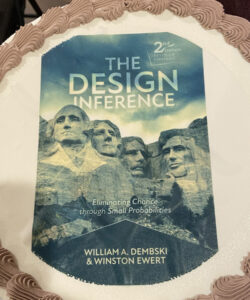
[In 2023] the second edition of The Design Inference… with Winston Ewert… give[s] specified complexity a fully mainstream information-theoretic formulation [as] a difference between Shannon and Kolmogorov information…
To round out my personal history with information, I need to mention my recent work on intelligence metrics. … These intelligence metrics assign numerical degrees of intelligence via probability and information measures… [The paper] develops a general theory of intelligence metrics based on information theory… By framing the measurement of intelligence in terms of search… the theory… applies across diverse causal settings, including human problem solving, large language models, and evolutionary processes… And that brings my personal history with information up to date.
These highlights only sketch a decades-long path. For the complete essay, read “My Personal History with Information” on Substack.